Tuesday, November 23, 2010

Module 6: Blog Comments
1. http://cybergogue.blogspot.com/2010/11/cmd-video.html
2. http://aimee-educ7102.blogspot.com/
3. http://bobstreff.blogspot.com/
4. http://middletonprinciplesdistanceeducation.blogspot.com/2010/11/module-6-revised-video.html
5. http://jamiwashington.blogspot.com/
2. http://aimee-educ7102.blogspot.com/
3. http://bobstreff.blogspot.com/
4. http://middletonprinciplesdistanceeducation.blogspot.com/2010/11/module-6-revised-video.html
5. http://jamiwashington.blogspot.com/
Thursday, November 11, 2010
Module 5 Blog Comments
1. EDUTechSpecial
http://chadwickeds.blogspot.com
2. PrinciplesofDistanceEducation
http://middletonprinciplesdistanceeducation.com
http://chadwickeds.blogspot.com
2. PrinciplesofDistanceEducation
http://middletonprinciplesdistanceeducation.com
Module 5: Concept Map: Static versus Dynamic Technologies
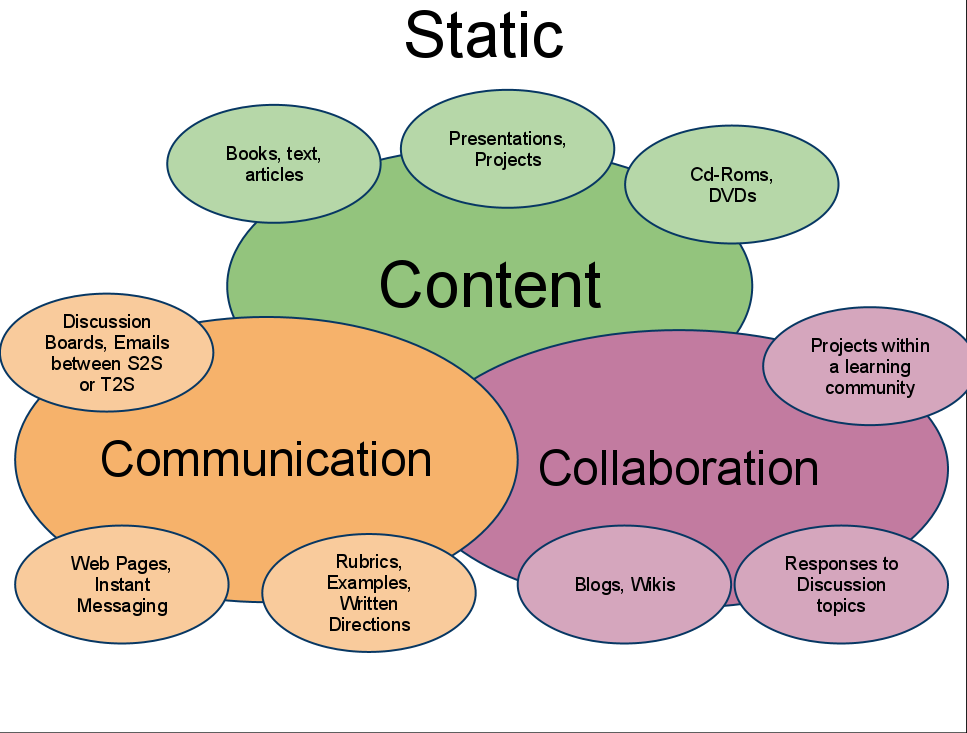

I think we need to first start with the definition of what is meat by static technology and dynamic technology. When we talk about static technology, we are addressing the the concept of NON-CHANGING. When we talk about dynamic technology, we are addressing the concept of CHANGE.
Lets start by addressing some issues in the static concept map. If we have content that is article or text form and it is printed into a text book and something changes about that particular topic--there is no way to truly update the printed material until the time comes for the article or text to be edited and reprinted. With the dynamic concept of content we could give our students a simulation activity, which I do each semester, that contains real life issues and problems and they would be able to walk away with a better understanding of the same topic that was being taught with static technology.
In my opinion there needs to be more dynamic technology but I don't think society is ready, nor do we need to "write-off" static technology. There should be a good medium ground that both forms of technology can meet.
Monday, October 25, 2010
Module 4: Blog Comments
1. EDUC-8842-1 Principles of Distance Education
http://bobstreff.blogspot.com/
2. EDUC 7102
http://aimee-educ7102.blogspot.com/
http://bobstreff.blogspot.com/
2. EDUC 7102
http://aimee-educ7102.blogspot.com/
Thursday, October 21, 2010
Module 4: Engaging Learners with New Strategies and Tools
In a distance education learning environment, teaching and learning has evolved to a point where both parties involved have a sense of satisfaction as far as what was taught and learned within the course. Before now, both the teacher and student felt more comfortable with face-to-face learning and felt there was more being gained from this type of environment. According to Durrington, Berryhill, &Swafford (2006), the importance of providing a learning environment that is supportive, open and respectful though the use of clear and detailed syllabus, responding to student inquiries in a timely manner and communicating explicitly the tone of responses, will help ensure a successful distance education course. Siemens' (2007), mentioned the importance of social presence, teacher presence and collaborative presence in distance education. These are equally important in ensuring a successful distance education class for all parties involved.
With the abundance of technological tools that are available in today's time, there is no reason the online learning community can't have a sense of "belonging" when it comes to distance education. By referring to the graphic organizer, you will see there are a number of tools available to make the teacher and learner feel like they are part of the learning community.
Durrington, V.A., Berryhill, A., & Swafford, J. (2006). Strategies For Enhancing Student Interactivity In An Online Environment. College Teaching, 54(1), 190-193.
Siemens, G. (2007) "George Siemens-Curatorial Teaching." Retrieved October 18, 2010 from http://www.archive.org/details/10MinuteLectures-GeorgeSiemens-CuratorialTeaching.

Friday, October 15, 2010
Module 3 Blog Comments
1. Principles of Distance Education
http://middletonprinciplesdistanceeducation.blogspot.com/
2. JShives11
http://jshives11.wordpress.com/
http://middletonprinciplesdistanceeducation.blogspot.com/
2. JShives11
http://jshives11.wordpress.com/
Wednesday, October 6, 2010
Social Presence Storyboard
Social Presence Storyboard
“Building Instructor and Social Presence”
Building Instructor and Social Presence February 7-9, 2011 Marriot in New Orleans, Louisiana Dr. Curt Bonk | Title, Date, Location and Keynote Speaker of Conference will be displayed on video There will also be pictures flowing in which shows the Marriot Hotel and conference room and a picture of Dr. Bonk. (I know people are already at the conference where this video will be shown and know the date of the conference and what the place looks like but it is still a good thing to include in case this video is used as a form of distance learning). |
Video Snippets of Keynote Speaker, Dr. Bonk | Within the video of me giving some background information about the topic and keynote speaker, I will have little snippets of Dr. Bonk talking about “Building Instructor and Social Presence” (Snippets will be taken from a video of Dr. Bonk at another conference. This video can be found on http://www.youtube.com/ ) |
PowerPoint Slides | A limited number of PowerPoint slides will “float” across the screen or will be shown temporarily on the video with key words or graphics to help keep the audience’s attention. The slide(s) will include information from the research I conducted on Social Presence. I will also tie the information that I learned about Dr. Bonk and his research into the research I conducted on the topic in general. |
Conclusion of Introduction of Speaker | Credits and References will be included at the end of the video |
Video Production: Introduction | The video starts with a video snippet of me welcoming the audience. I will also include conference details as stated in the first cell of this table. |
Video Production: Social Presence in Distance Education | I will define what “social presence” means when it comes to distance education and will include a short video snippet of Dr. Bonk that is retrieved from one of his conferences where he spoke about the importance of social presence in distance education. (approximately 20-30 seconds) By including this snippet, it will keep the audience “hungry” for more of what Dr. Bonk has to say about the topic. |
Video Production: Interview | I will shoot a video of an interview of what an individual thinks about distance education VS face-to-face education. Does this individual feel as successful in a distance education course, etc? This video will be short (approximately 30 seconds) |
Video Production: How to ensure social presence is part of DE | I will state some facts from research that I have conducted on how to make social presence part of DE and how to make sure it is effectively present in DE. While I am talking about this information I will have the key words appearing on the screen and will include pictures to show it being implemented. |
Video Production: Introduction of Dr. Bonk | I will show a picture of Dr. Bonk as I am officially introducing him and will give the audience information about his credentials. |
Monday, September 27, 2010
Module 2 blog comments
The following blogs were commented on by me:
1. Dave Harm's Blog
http://daveharms.wordpress.com/2010/09/27/module-2-post/#comment-47
2. CwTurners Blog
http://cwturner2002.wordpress.com/
1. Dave Harm's Blog
http://daveharms.wordpress.com/2010/09/27/module-2-post/#comment-47
2. CwTurners Blog
http://cwturner2002.wordpress.com/
Module 2: Global Diversity in Distance Education
I agree with the statements George Siemens stated in the video. George Siemens talked about how distance education has moved to a point where meaningful relationships are being made. The location of the learners within the class is not an issue anymore due to the online tools that are available. The learners within the learning community have become comfortable with the thought of distance education and the thought of communicating with people from other parts of the state/world. Distance education allows for great opportunities when communicating with others from around the world. The learners get to see things from a point they may not have ever had the opportunity to experience prior to distance education.
Global Diversity has become a prominent part of distance education. With so many universities offering online courses and so many learners taking advantage of this type of higher education, we are able to have a more diverse group within a class. Some learners that may live in a rural area may not have the same experiences as someone that lives in a urban area but with the tools that available and distance education being available, these two types of learners are able to be in the same class, sharing their experiences and learning from one another.
There are a variety of tools available to make global diversity a part of distance education. One tool is the fact that so many universities have courses set up through an online program that allows the learners to chat with one another, have discussions over specific topics and share general thoughts and information about themselves. Another great tool that is available are programs like Skype. This type of programs allowing people to chat, view one another live from their location, etc. The learners could actually have a conversation with one another and see one another while being in different parts of the world.
Siemens, G.. (n.d) "The Future of Distance Education" Laureate Education, Inc. Retrieved September 20, 2010.http://sylvan.live.ecollege.com/ec/crs/default.learn?CourseID=4449103&Survey=1&47=6857070&ClientNodeID=984645&coursenav=1&bhcp=1
Module 1 Blog Comments
The following blogs were commented on for Module 1:
1. EDUTechSpecial
http://chadwickeds.blogspot.com/2010/09/module-1-blog.html#comments
2. EDUC 8842
http://daveharms.wordpress.com/2010/09/14/educ-8842-blog-1/
1. EDUTechSpecial
http://chadwickeds.blogspot.com/2010/09/module-1-blog.html#comments
2. EDUC 8842
http://daveharms.wordpress.com/2010/09/14/educ-8842-blog-1/
Friday, September 17, 2010
Module 1: The Next Generation
As distance education students we are all aware that this is the "Next Generation" to eduation. As adults, we all have busy lives and we some how have to find a way to fit our desire for higher education into this schedule. Distance education will not be "fading in the near future" but instead will continue to grow and replace more of the traditional face-to-face courses.
Simonson (2008) mentioned the fact that distance education will never be able to offer the same as face-to-face instruction, but instead that the instructions should be equal. I feel very privelaged to have participated in a number of distance education courses, even when I was enrolled at a university in my home town. The opportunties that I found in my distance education courses versus face-to-face instruction were beneficial. I wasn't as resistant to share my thoughts in opinions in the online courses, where as in the face-to-face courses, I often sat there and allowed everyone else to do the thinking, whether I agreed or disagreed.
Huett, Moller, and Foshay (2008) talk about key areas in which distance education can be improved. These areas affect the students ability to retain the knowledge and the impact they have to a technological society. Students and teachers should have a sense of collaboration in their online course and feeling that what they learn can be transferred to their everyday life.
I do agree with what is being said by all parties but I also think that there needs to be an imaginary line between a person's professional life and a person's personal life. I have a facebook page and I often have students wanting to befriend me but I chose to not have that connection due to the professional aspect and respect I want from my students. I do not ever post anything inappropriate on Facebook but I don't want my students to see the more casual side of me.
References:
Moller, L., Foshay, W., & Huett, J. (2008a, May/June). The evolution of distance education: Implications for instructional design on the potential of the Web (Part 1: Training and Development). TechTrends, 52(3), 70–75.
Moller, L., Foshay, W., & Huett, J. (2008b, July/August). The evolution of distance education: Implications for instructional design on the potential of the Web (Part 2: Higher Education). TechTrends, 52(4), 66–70.
Huett, J., Moller, L., Foshay, W. & Coleman, C. (2008, September/October). The evolution of distance education: Implications for instructional design on the potential of the Web (Part 3: K12). TechTrends, 52(5), 63–67.
Simonson, M.. (n.d) “Distance Education: The Next Generation” Laureate Education, Inc. Retrieved September 9, 2010 http://sylvan.live.ecollege.com/ec/crs/default.learn?
Tuesday, September 7, 2010
Subscribe to:
Posts (Atom)